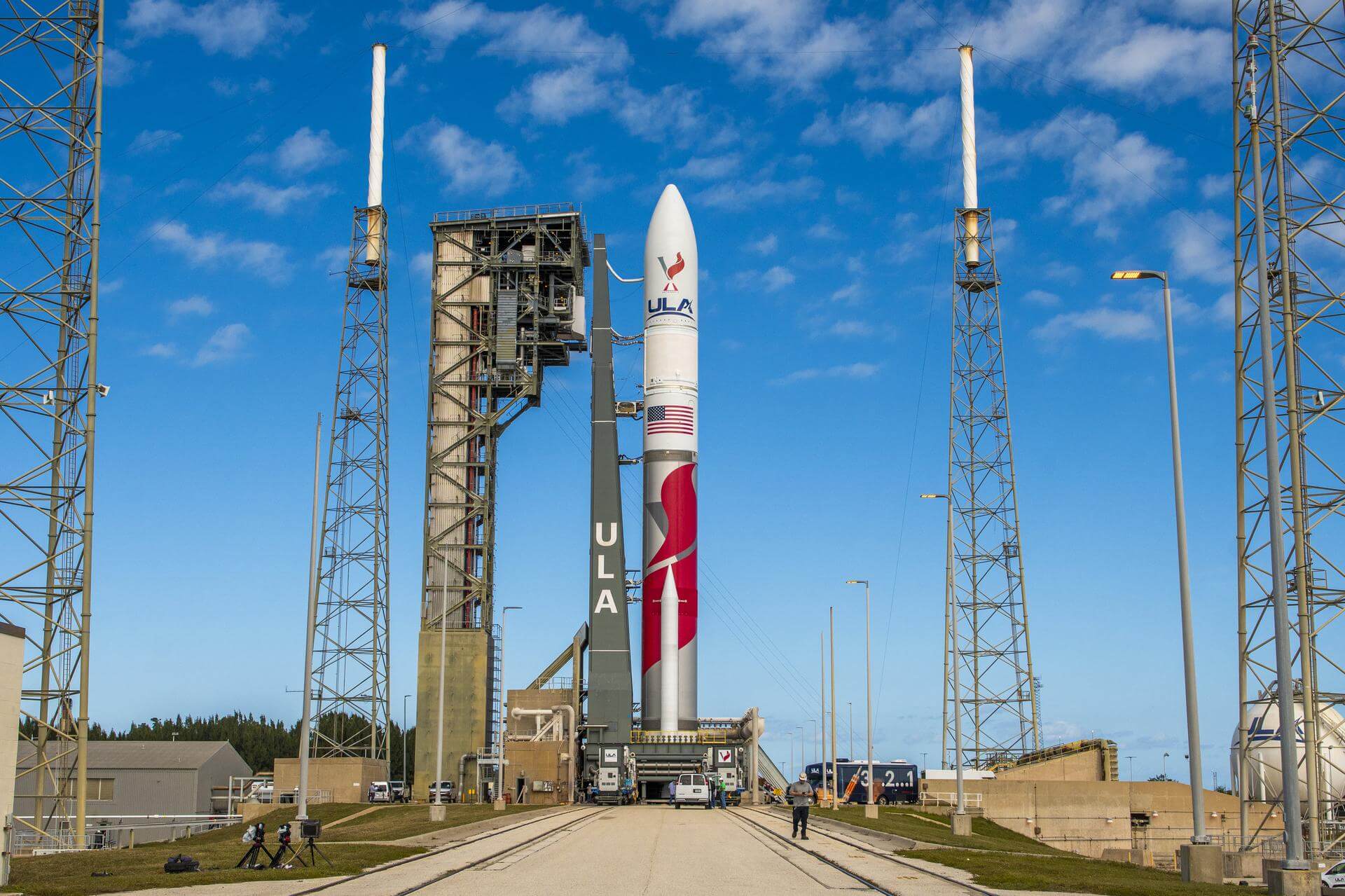
Vulcan | SILENTBARKER 2/NROL-118
Space domain awareness mission for the US Department of Defense.

Space domain awareness mission for the US Department of Defense.

Impulse Space's Mars Lander is designed to support research and development needed for human exploration of Mars.

Payload consists of a single Pelican high-resolution imaging satellite for Planet Labs Germany.

24 satellites for Rivada's internet constellation.
First test launch of Deep Blue Aerospace’s Nebula-1 rocket. The test flight profile is reported to be sub-orbital.

24 satellites for Rivada's internet constellation.

24 satellites for Rivada's internet constellation.

Tranche 1 Tracking Layer D is one of five missions by the United States Space Force Space Development Agency (SDA) for the Proliferated Warfighter Space Architecture (PWSA) Tranche 1 Tracking Layer constellation, which will provide global indications, warning, tracking, and targeting of advanced missile threats, including hypersonic missile systems.

24 satellites for Rivada's internet constellation.

TDS-01 (Technology Demonstration Satellite-01) is an Indian geostationary orbit technology demonstration satellite carrying payloads for the Indian Space Research Organisation (ISRO)’s Institute of Plasma Research, Gandhinagar and the CSIR-CEERI, Pilani. Payloads to be tested included an internally developed 300 mN electric powered thrusters, atomic clocks, travelling wave tube amplifiers (TWTA) & a quantum communication suite (QuTDS).

QuickSounder is the first satellite mission of the Near Earth Orbit Network (NEON) program of the National Oceanic and Atmospheric Administration (NOAA), which aims to replace the current Joint Polar Satellite System (JPSS) series of polar orbit weather satellites. This pathfinder mission will demonstrate NOAA's ability to launch a small satellite within 3 years, flying a refurbished Advanced Technology Microwave Sounder (ATMS) instrument to polar orbit.

CHORUS is MDA's next generation Earth observation constellation, consisting of 2 radar satellites (C-band SAR and X-band SAR), in a 53.5 degree 600 km altitude LEO, with the X-band trailing the C-band by 60 minutes. A collaborative multi-sensor constellation, CHORUS will bring together diverse and unique imagery and data sources and provide a new level of near real-time insight and innovative Earth observation services. Operating in a unique mid-inclination orbit, CHORUS will be able to image day or night, regardless of weather conditions, with daily access of up to 95% of the coverage area. From an industry-leading 700km-wide imaging swath down to sub-metre high resolution, CHORUS will provide the most extensive and unrivalled Earth observation radar imaging capacity available on the market in a single mission.